


GENERAL TERMS AND CONDITIONS OF RENTAL
June 2024
ARTICLE 1 – DEFINITIONS
Whenever they are used in the body of the Contract, the terms referred to below shall have the following definitions:
- “the Quote”: This term refers to the technical conditions, price, and timeframe for the Equipment rental. The accepted Quote, signed by the Lessee, forms the Contract. The Quote is inseparable from these General Terms and Conditions of Rental.
- ” The Hirer“: This term refers to the company TIBBLOC, registered in the NANTES Trade and Companies Register under number 500 358 221, whose head office is located at 1, Le Breuillet 44450 Saint Julien de Concelles.
- ” The Lessee“: This term refers to the legal entity to which the Lessor rents the equipment under the terms of the Contract. The identity and contact information of the Lessee are specified in the Quotation.
- ” The Parties“: This term refers to the parties to the Contract, i.e. the Renter and the Hirer.
- ” The Contract“: This term refers to the Quotation and these Rental Terms and Conditions. These documents govern the contractual relationship between the Lessor and the Lessee and constitute a contract.
- ” Equipment“: This term refers to the equipment(s) owned by the lessor and leased to the lessee under the Agreement. The equipment, as well as any accessories, leased to the Lessee are precisely detailed in the Quote.
ARTICLE 2 – PURPOSE
The purpose of these General Terms and Conditions of Rental (hereinafter “GTC”) is to define the conditions under which the Lessor agrees to rent the Equipment to the Lessee, who accepts.
The specific terms and conditions of the rental are described in the Quote, including the type and characteristics of the Equipment to be rented, the duration of the Contract, and the start date of the Equipment rental.
The GTC prevail over any contrary clause(s) that may appear in the Lessee’s documents, particularly its own (framework) contracts or general conditions.
For the purposes of the Contract, the Parties declare their election of domicile at their respective registered offices, which are specified in the Quote.
ARTICLE 3 – DECLARATIONS OF THE LESSEE AND THE LESSOR
The Lessee hereby declares having made all the prior declarations and/or has all the administrative authorisations required for the operation, installation and operation of the leased Equipment.
The Lessee must inform the Lessor of the specific conditions of use of the Equipment so that the rules of use and safety set by both the applicable regulations and the manufacturer and/or the Lessor can be specified.
All consequences that may arise from non-compliance with the aforementioned conditions will be borne by the Lessee, without the Lessor’s liability being sought on any grounds whatsoever. Any associated additional costs (e.g., additional storage fees) will be borne by the Lessee.
The Lessor declares that the Equipment complies with the regulations in force on the date the Contract is signed.
ARTICLE 4 – FORMATION OF THE CONTRACT
Based on the needs expressed by the Lessee, the Lessor drafts a Quote. The Quote is valid for 1 month from its date of issue unless otherwise specified in the Quote.
The Lessor provides the Lessee with the Quote, which the latter accepts by signing it and/or by issuing a purchase order to the Lessor that must expressly refer to the Quote. The Parties may negotiate special conditions, in compliance with the Quote. The GTC attached to the Quote will be accepted de facto upon signing the Quote, without reservation or restriction.
Upon formation of the Contract, the Lessor also provides a manual containing care and maintenance instructions for the Equipment, which the Lessee is required to follow.
The formation of the Contract occurs upon acceptance of the Quote by the Lessee in any form whatsoever; the Lessee’s commitment can be proven by any means.
Any cancellation of a rental by the Lessee before the date the Equipment is made available will result in the Lessor invoicing an indemnity corresponding to 30% of the total amount (incl. VAT) of the accepted Quote up to one week before the delivery date (100% for a period of less than one week).
In the event of a shift in the delivery date, the lessor reserves the right to modify the weekly price if the overall duration is shortened. For a notice period of less than 2 weeks, the Contract and invoicing will begin on the date initially scheduled in the Quote.
ARTICLE 5 – TRANSPORT – DELIVERY – UNLOADING
5.1. – Transport
Unless otherwise specified in the Quote, the Equipment is transported by the Lessor.
In the event that the transport is performed by the Lessee, the handling costs of the Lessor may be re-invoiced. It is the Lessee’s responsibility to have all ad hoc insurance to carry out the transport and handling of the rented equipment. The Lessee undertakes to respect best practices in terms of transport and handling (cf. lifting plans).
The costs of transport are fully borne by the Lessee.
When the transport of the Equipment is provided by the Lessor, the amount of the transport costs is specified in the Quote.
5.2. – Delivery
The delivery location of the Equipment is specified in the Quote.
The delivery date is mentioned in the Quote.
The Lessor hereby undertakes to deliver the Equipment to the Lessee in perfect working order and provided with all of the necessary documents, in particular the notice containing the instructions for the correct upkeep and maintenance of the Equipment, the user manual for the Equipment’s sub-equipment and all technical documentation. The documentation is systematically present at the facilities. If, however, such documents are missing or disappear during the lease term, it is the responsibility of the Lessor to make such a claim.
The Lessee is hereby required to provide the Lessor with all of the safety instructions and/or instructions to access the delivery location with which the Lessor must comply to make the delivery.
The Tenant is solely responsible for any damage caused to hidden installations and/or structures (networks, pipes, buried cables, etc.).
The Lessee is also required to notify its staff of the delivery to be made by the Lessor in order to guarantee the Lessor’s access and delivery of the Equipment to the location provided for this purpose.
In the event that delivery is impossible to carry out and/or suffers any delay due to the Lessee and/or third parties, the Lessee shall be liable to the Lessor for an indemnity for the period starting from the initially scheduled delivery date until the actual delivery date. The amount of this indemnity will correspond to the rental amount provided for in the Quote. The Lessee will also be liable for the additional transportation costs incurred by the Lessor.
The Lessee will be present at the delivery location to receive the Equipment. The Lessee will sign the delivery slip.
When damage is noted upon delivery of the Equipment, the Lessee must then make the necessary reservations with the carrier and transmit them immediately to the Lessor so that the latter can take the necessary measures with their respective insurance companies.
5.3. Unloading the Equipment
Unless otherwise provided in the Quote, the unloading of the Equipment is handled by the Lessor.
Authorisation requests necessary for unloading operations, especially parking permits, are the responsibility of the Lessee.
When the Equipment cannot be unloaded on the specified location for installation, any equipment or vehicle necessary to allow its transfer to the specified location is provided by the Lessee.
During the unloading period, the Party liable for damage arising from the related operations is the Party in charge of the operation. The Lessee nevertheless remains responsible for any damage caused to non-apparent installations and/or structures (networks, pipes, underground cables, etc.).
Taking possession of the Equipment transfers legal custody of the Equipment to the Lessee.
ARTICLE 6 – INSTALLATION OF THE EQUIPMENT – CONNECTION – COMMISSIONING – ASSESSMENT
The participation of the Lessor’s staff for the installation, assembly and dismantling operations is limited to its scope of competence and can in no way have the effect of reducing the Lessee’s liability, particularly in terms of safety.
6.1.- Installation of the Equipment
The preparation of the site planned for the installation of the Equipment and, in particular, the ground is the responsibility of the Lessee. In the event that the site is not suitable due to its position, condition and/or composition (sloping etc.), the Lessee hereby undertakes to perform all of the work (installation of foundation[s], planks, etc.) enabling the installation of the Equipment. This work must be performed before the delivery of the Equipment. The Lessor can in no way be held responsible for the impossibility of and/or delay in delivery resulting from non-compliance with the aforementioned obligations.
The Lessor installs the Equipment. The installation costs are fully borne by the Lessee and specified in the Quote.
The Lessee takes charge of all equipment (lifting, handling, craning, etc.) necessary for the installation, the cost of which is specified in the Quote.
6.2. Electrical connection
The electrical connection of the Equipment on the site is performed by the Lessee under its sole responsibility. The electrical connection of the Equipment to the site’s main switchboard (TGBT) is carried out by the Lessee under their sole responsibility.
6.3. Commissioning the Equipment
The Lessor commissions the Equipment.
In the event that the Equipment is placed into service by the Lessee, the Lessee will be solely responsible for any ensuing damage or malfunction. After the installation and commissioning of the Equipment, the Equipment will be considered in perfect working order except for reservations expressed by one or other of the Parties either on the commissioning form regarding the Lessor or by mail within 24 hours for the Lessee.
ARTICLE 7 – USE OF THE EQUIPMENT
7.1 The Lessee undertakes to, without this list being exhaustive:
- taking care of the Material ;
- do not make any modifications;
- do not move the equipment;
- carry out the analyses/studies required to use the equipment in compliance with applicable regulations;
- do not seal the hardware, so that it remains removable;
- if necessary, use the appropriate quality fuel for the Equipment and ensure its proper operation;
- if necessary, provide the appropriate electrical power to supply the Equipment;
- comply with all the technical documentation supplied (or equivalent documents), the manufacturer’s and the Hirer’s recommendations and instructions for use relating to the Equipment, and in particular ensure that the Equipment is not overloaded, i.e. that the nominal capacity of the equipment is exceeded;
- carry out the necessary checks and regular servicing and maintenance operations as defined in the equipment’s technical manuals;
- operate or have operated by competent personnel ;
- use a water quality defined in the manufacturer’s technical specifications;
- not to make abnormal use of the Equipment;
- comply with all applicable regulations, in particular safety standards;
- file declarations or authorizations as an operator with the relevant institutions;
- report to the Hirer any malfunction related to normal use of the Equipment and not operate the Equipment if it has become defective, damaged or dangerous;
- not to sub-rent/lend the Equipment, except with the express agreement of the Lessor. However, in the context of emergency interventions, the Lessor cannot object to the use of the Equipment by other companies. The Lessee nevertheless remains bound by the obligations of the Contract. Furthermore, for the needs of the Lessee’s work sites, the latter may be required to entrust the use of the Equipment to third parties. In this case, the Lessee remains bound by the obligations of the Contract.
The Lessee alone bears all expenses of any kind whatsoever, present or future, relating to the rental, use or operation of the Equipment, with the exception of those charged to the Lessor by law.
Any use not in accordance with the Lessee’s prior declaration or the normal purpose of the Equipment gives the Lessor the right to terminate the Contract (Article 14.2 GTC) and demand the return of the Equipment.
7.2 The Lessee undertakes to allow the Lessor access to the Equipment during business days and hours, subject to the Lessor providing 24 hours’ notice, in order to ensure their condition and the Lessee’s compliance with the obligations set out in the Contract.
ARTICLE 8 – UPKEEP, MAINTENANCE AND REPAIR OF EQUIPMENT
8.1. – Upkeep and maintenance
8.1.1 Obligations of the Lessee
Unless otherwise specified in the Quote, the care, maintenance, and operation of the Equipment are the responsibility of the Lessee.
The Lessee undertakes to perform the regular maintenance of the Equipment by authorised and competent personnel, in accordance with the manufacturer’s instructions.
Under maintenance, the Lessee has, non-exhaustively, the obligation to:
- assume responsibility for repairs to the Equipment in the event of malfunction, breakage or breakdown resulting from abnormal use of the Equipment, negligence or accident;
- ensure that the equipment is in good working order and carry out the various checks specified in the technical manuals;
- replace wearing parts;
- carry out all servicing and checks recommended by the Owner, the manufacturer and the regulations in force;
- perform safety tests ;
- protect the Equipment against any climatic event, in particular frost, snow, fire, etc.
8.1.2 – Subscription by the Lessee to an upkeep and maintenance option and stocks of operational spare parts
If necessary, the Lessor may offer the Lessee the option of purchasing an upkeep and maintenance option and/or stocks of operational spare parts.
If the Lessee subscribes to the upkeep and maintenance option, the Lessee may choose from several levels of involvement offered by the Lessor. The selected upkeep and maintenance service is detailed in the Quote and the informational leaflet.
The amount charged by the Lessor for the upkeep and maintenance option and/or stocks of operational spare parts chosen by the Lessee is specified in the Quote.
8.2- Repair of the Equipment
8.2.1 The Lessee undertakes to notify the Lessor in writing and within a maximum of 48 hours of any breakdown or incident affecting the Equipment.
When the breakdown or incident results from the normal use of the Equipment and is due to its poor condition or a hidden defect, the Lessor proceeds, at its own expense, to repair the Equipment. When the repair procedure requires the immobilisation of the Equipment for more than two days, the Lessor undertakes to communicate to the Lessee the foreseeable duration of the immobilisation. Replacement equipment may, if necessary, be made available to the Lessee. If no replacement Equipment is made available to the Tenant, the Contract is suspended with regard to the payment of rent for the period during which the Equipment is unavailable.
When the breakdown or incident results from the abnormal use or an operating fault due to the Lessee, the repair costs are the responsibility of the Lessee.
The Hirer will repair the Equipment as soon as possible, and will invoice the Hirer for the repair service.
If, however, the Lessee replaces or has parts replaced on the Equipment, the Lessee undertakes to replace them identically, otherwise the replacement of the parts, performed upon return to the Lessor’s workshop, will be invoiced.
During this period, the Contract is not suspended. Replacement equipment may, if necessary, be leased to the Lessee as part of a new quote that will not replace the initial one.
8.2.2. The Lessee undertakes to guarantee access and the best working conditions for the Lessor’s technicians required to intervene on site. The rules relating to the safety of the environment in which the Lessor’s technicians operate remain within the competence of the Lessee and under its exclusive authority.
In the event that the Lessor’s technician cannot access the site or the Equipment, the waiting time will be invoiced to the Lessee.
The provision of assistance and, if necessary, handling equipment is the responsibility of the Lessee.
ARTICLE 9 – RETURN – DISMANTLING – LOADING
9.1. – Return of the Equipment
9.1.1. The Lessee undertakes to return the Equipment in perfect working order and in its entirety.
The Equipment must show a normal state of wear and must be clean.
Under the conditions set out in article 12 of the CGL, the Hirer shall be fully liable to the Rental Firm for any theft, loss, damage or deterioration suffered by the Equipment during the rental period.
During the removal from service, the Lessor will perform a visual examination of the Equipment with the Lessee. A full report will be produced upon return to the Lessor’s workshop.
In the event of damage or abnormal wear and tear, all repair costs will be borne by the Lessee. The Lessor will then transmit a report of the defects and the Lessee will have 24 hours to contest it in case of disagreement.
9.1.2. The Lessee acquires no ownership rights to the Equipment. All of its parts remain the property of the Lessor, whether or not they have been invoiced to the Lessee or replaced by the Lessee.
On the other hand, the Lessee ensures the custody of the Equipment throughout the rental period.
9.2 – Dismantling and loading of the Equipment
The Lessor proceeds with the dismantling and loading of the Equipment, after having been notified in writing one week in advance of the exact date of the performance of this service.
The dismantlement costs are fully borne by the Lessee and specified in the Quote.
The authorisation requests necessary for the loading operations are the responsibility of the Lessee.
When the lease includes a non-ADR fuel tank, the Lessee pumps the fuel and degasses this tank to allow its return to be performed. The Lessee can also choose to have the Lessor to perform this service, in which case the price relating thereto will appear in the Quote.
The Lessee is required to provide the Lessor with all the safety and/or access instructions that the Lessor must follow to access the Equipment and perform the loading.
ARTICLE 10 – SCOPE OF RENTAL – DURATION OF RENTAL AND RETURN PERIOD
10.1. – Lease period
The rental is granted for the duration specified in the Quote and cannot be less than one calendar week.
Any week started is due in full.
When the Contract is concluded, it takes effect from the date the Equipment leaves the Lessor’s premises and ends on the date the Equipment is returned.
When the Lessee wishes to extend a Contract concluded for a fixed term, they must notify the Lessor at least 8 calendar days in advance. The Contract will be extended, if applicable, by mutual agreement. In the absence of a signed extension amendment, and in the event that the Equipment is in the Lessee’s possession, the rental duration will then be tacitly renewed under the terms of the Contract to cover the rental until the date the Equipment is returned.
10.2. – Deadline for returning the Equipment
The Lessee shall notify the Lessor in writing of the exact desired dismantling date 5 working days before the end date of the Contract.
In the event of a delay in returning the Equipment, the Lessee shall be liable to the Lessor for an indemnity corresponding to twice the amount of the rental installment provided for in Article 11 of the GTC, the Contract being deemed tacitly renewed under the conditions of Article 10.1 of the GTC.
In the event of a delay in returning the Equipment exceeding two months, the Lessor shall be entitled to invoice it to the Lessee at the new replacement price, the Contract being deemed tacitly renewed under the conditions of Article 10.1 of the GTC.
ARTICLE 11 – PRICE
11.1. – Contract Amount
The amount for the Equipment rental, price revisions, as well as the costs of any optional services subscribed to by the Lessee, are specified in the Quote. The applicable VAT is that in force on the day of the taxable event.
The price in the Quote is subject to revision under the conditions defined therein.
Fuel: unless otherwise stated in the Quote, the Lessee undertakes to pay the Lessor the price of the fuel necessary for the use of the Equipment.
Once the initial consumption is exhausted by the Lessee, the Lessor will resupply the Lessee to maintain the operation of the Equipment. An amendment will be formalized based on the economic conditions in force.
In accordance with current regulations (ADR), tanks with a capacity greater than 3,000 liters must be returned by the Lessee empty and degassed without fuel recovery; the Lessor is not bound by any obligation to the Lessee to take back the fuel.
The fuel price is subject to weekly revision.
11.2. -Lease payment period
The payment period of the lease will begin on the date of removal of the Equipment from the Lessor and will end on the date of its return to the Lessor. Any week started is due.
11.3. – Terms of payment
Unless specific conditions are stipulated in the Quote, the rent and the prices of any optional services subscribed to by the Lessee are due and payable monthly in arrears, with the first installment fixed in relation to the day the Equipment is made available to the Lessee and subsequent installments fixed on the anniversary date of each month.
Unless otherwise stated in the Quote, the payment term is 30 days from the invoice date.
The lease payments are made either by bank transfer or by direct debit.
No discount is applied in the event of cash or lease payments in advance of the date appearing on the invoice issued.
11.4.- Late Payment Penalties
In the event of late payment by the Lessee, late payment penalties, corresponding to a percentage of the total amount (incl. VAT) of the sums due by the latter, will be automatically and rightfully acquired by the Lessor starting from the day following the invoice due date, without any formality or prior formal notice, and without prejudice to any other action that the Lessor would be entitled to bring, in this respect, against the Lessee. These late penalties will be calculated on the basis of a rate equal to the interest rate applied by the European Central Bank to its most recent refinancing operation plus 10 percentage points.
In the event of late payment, the Lessee will also be liable to the Lessor for a lump sum compensation for recovery costs in the amount of 40 euros. If the recovery costs incurred by the Lessor are greater than the amount of this fixed compensation, the Lessor may request additional compensation, upon presentation of receipts.
11.5. Penalty clause
In addition to the late penalties provided for above, in the event of the non-payment by the Lessee of the full amount of the invoice at the end of a period of one month running from its due date, the Lessee will be liable to the Lessor, automatically and without prior notice, for compensation equal to 25% of the balance, including taxes, remaining due.
ARTICLE 12 – LESSEE’S LIABILITY – INSURANCE – LIMITATION OF THE LESSOR’S LIABILITY
12.1. – Responsibility of the Lessee
12.1.1. Throughout the lease period of the Equipment, the Lessee is solely responsible for any damage or degradation, of any nature whatsoever, accidental or not, caused to the Equipment.
The Lessee is solely liable to the Lessor for the loss or theft of the Equipment.
In the cases referred to in this article, the Lessee’s liability includes in particular:
- the replacement cost of the Equipment corresponding to its new value;
- the cost of repairing and restoring the Equipment;
- any rental costs for replacement Equipment.
The Lessee is solely responsible for any breach of the laws and regulations in force.
12.1.2. In the event of theft or break-in of the Equipment, the Lessee undertakes to immediately notify the Lessor in writing and to file a complaint with the competent authorities.
The Lessee must give the Lessor, within two working days, a receipt for the filing of such complaint.
12.2. – Insurance
12.2.1 The Lessee is solely responsible for the monitoring, custody, and use of the Equipment and is liable for any damage caused to it and/or caused to third parties by their actions.
Throughout the duration of the Contract, the Lessee undertakes to maintain civil liability insurance taken out with a notoriously solvent company, covering bodily injury, environmental, material, and immaterial damage caused to third parties due to the possession and use of the Equipment.
12.2.2 By accepting the Quote, the Lessee accepts the “Machinery Breakdown” coverage taken out by the Lessor with its insurer, covering damage caused to the Equipment, under which the Lessee accepts the waiver of recourse by the Lessor and its insurer.
The cost of this guarantee is included in the price of the Quote.
Upon written request from the Lessee, the Lessor will provide the limits of the commitment made, particularly regarding the amounts of guarantees, deductibles, exclusions, and conditions for the insurance’s waiver of recourse against the Lessee.
This guarantee exclusively covers damage caused to the Equipment in the context of normal use, according to the conditions of the Quote and the GTC, and for the geographical area provided for in the Contract.
Excluded from the guarantee are a) damage resulting from characterized or intentional negligence, non-compliance with manufacturer and/or Lessor recommendations, b) damage caused by unqualified or unauthorized personnel, c) theft of the Equipment and its components such as cables, consumables, hoses, and ducts, which will consequently be invoiced at the new replacement value to the Lessee in case of damage, d) defects resulting from acts of vandalism, e) costs incurred to clear the damaged Equipment.
The Lessor reserves the right to seek recourse against the responsible third party or their insurance company.
12.2.3 The Lessee undertakes, throughout the duration of the Contract, to maintain insurance taken out with a notoriously solvent company, with the benefit assigned to the Lessor, covering, non-exhaustively, damage of any kind, accident, fire, theft, vandalism, and water damage, as well as the exclusions from the “Machinery Breakdown” guarantee referred to in Article 12.2.2 of the GTC, for the new replacement value of the Equipment.
Prior to handing the Equipment over to the Lessee and thereafter upon the Lessor’s simple request, the Lessee must provide proof to the Lessor of the subscription to such insurance by providing certificates from its insurance companies listing the coverage subscribed, its amount, its period of validity and the commitment made by the insurance companies at issue to pay the indemnity directly to the Lessor.
In the absence of providing these certificates before the delivery of the Equipment, or if they do not meet the previously mentioned conditions, the Lessor may subrogate to the Lessee’s rights against their insurance company.
12.2.4 If the Lessee refuses the “Machinery Breakdown” guarantee as provided for in Article 12.2.2 of the GTC, the Lessee must take out insurance covering the Equipment as well as the damage referred to in Article 12.2.3 of the GTC. It must then be taken out at the latest on the day the Equipment is made available and must be maintained for the duration of the Contract. At the latest when the Equipment is made available, the Lessee undertakes to provide the Lessor with the insurance certificate corresponding to the Contract, including in particular the commitment made by the insurance company to pay the indemnity into the hands of the Lessor, the Contract references, the amount of guarantees, and deductibles. Any limits, exclusions, and deductibles resulting from the insurance contract taken out by the Lessee are unenforceable against the Lessor with regard to the Contract commitments. In the event of damage to the Equipment, the Lessee and its insurers waive all recourse against the Lessor and its insurers. In the event that the Lessee insures the Equipment, the loss will be assessed:
- for repairable equipment: depending on the cost of repairs
- for non-repairable or stolen Equipment: at replacement value less a coefficient of wear and tear determined by an expert or, failing that, in the special conditions.
12.2.5 In the event of damage or theft of the Equipment, the Contract ends on the day the Lessor receives the claim declaration from the Lessee.
Indemnification for the Equipment by the Lessee to the Lessor is made without delay, based on the replacement value with new equipment on the date of the loss. In all cases, the Lessee is liable for a minimum flat-rate indemnity of: 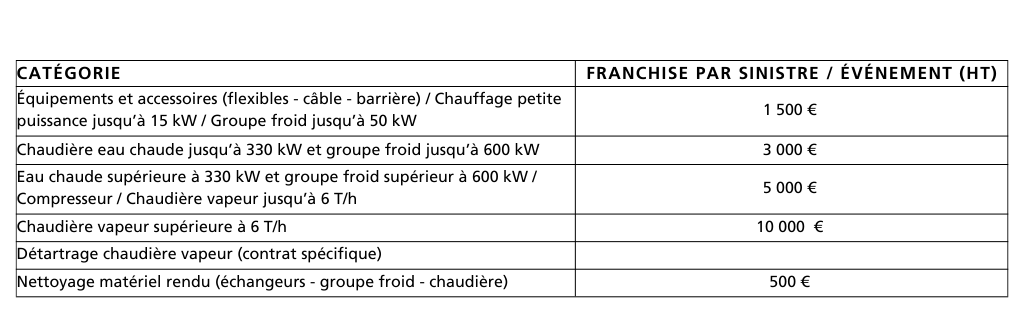
The indemnity paid by the Lessee does not result in the sale of the damaged Equipment, which remains the exclusive property of the Lessor. Only the latter decides whether or not to proceed with the repair.
12.3 Limitation of the Lessor’s Liability
During the Contract, in the event that the Lessor’s liability could be engaged due to direct material damage caused by the Equipment, it will be limited to the total amount of rent to be paid by the Lessee during the period of application of the Contract.
On the other hand, the Lessor’s liability cannot be engaged by the Lessee in the event of indirect or immaterial damage, such as direct or indirect operating and/or production losses, caused to the Lessee by their actions or those of the Equipment.
Beyond these limits and conditions, the Lessee and its insurers waive all recourse against the Lessor and its insurers.
ARTICLE 13 – SUSPENSION OF THE PARTIES’ OBLIGATIONS
13.1 Incident resulting from normal use of the Equipment
The Lessee informs the Lessor of any incident resulting from normal use and affecting the enjoyment of the Equipment. The Lessor then takes all necessary measures to restore the Equipment, which results in the suspension of the Contract for the corresponding time.
If the suspension exceeds one month and except for fault on their part, the Lessee will be entitled to terminate the Contract by sending a registered letter with acknowledgment of receipt.
13.2 Force majeure
The Parties hereby agree that the obligations of the Lessor or the Lessee will be automatically suspended and their liability cannot be invoked upon the occurrence of a force majeure event as defined in legislation and case law.
The suspension of the obligations or the delay may in no case induce the payment of damages or late penalties.
The Party noting the event must immediately inform the other Party as soon as possible by registered letter with acknowledgment of receipt.
However, as soon as the cause for the suspension of their reciprocal obligations disappears, the Parties will make every effort to resume the normal performance of their contractual obligations as quickly as possible.
ARTICLE 14 – EARLY TERMINATION
14.1 Occurrence of a force majeure event
When the force majeure event referred to in Article 13.2 of the GTC has become definitive or generates such a delay that it prevents the continuation of the rental, the Contract may be terminated by one of the Parties by sending the other Party a registered letter with acknowledgment of receipt.
The termination will take effect automatically on the date of the first postal presentation of the registered letter.
14.2 Contractual non-performance attributable to one of the Parties
The Contract may be terminated at any time by either Party in the following cases:
- The sufficiently serious breach of one or more of its obligations by the other Party, which has become final or continues beyond eight (8) calendar days;
- Non-compliance by the Tenant with its obligation to pay an invoice, persisting beyond thirty (30) calendar days from the invoice due date.
The termination of the Contract by one of the Parties will occur automatically at the end of a period of eight (8) calendar days from the receipt, or failing that, the first postal presentation, of a formal notice letter addressed by one of the Parties to the other by registered letter with acknowledgment of receipt or any extrajudicial act, mentioning the intention of its author to apply this clause and remaining without effect.
In the event of early termination of the Contract resulting from a failure by the Lessee to perform its contractual obligations, the latter will be liable to the Lessor for an early termination indemnity corresponding to all rent due until the normal term of the Contract, increased by 15%.
14.3 Lessee’s Request
The Contract may be terminated at the written request of the Lessee.
In such a case, the Lessee will be liable to the Lessor for an early termination indemnity corresponding to all the rents due until the normal end of the Contract.
14.4 Unforeseeability
The Parties may terminate the Contract by mutual agreement in the event of a change in circumstances that was unforeseeable at the time of its conclusion and makes its performance excessively onerous for one of the Parties, in accordance with Article 1195 of the Civil Code.
Any early termination of the Contract results in the return of the Equipment in accordance with Article 10.2 of the GTC.
ARTICLE 15 – ASSIGNMENT OF CONTRACT
The Contract is concluded “intuitu personae”.
The Lessee may not, as a primary or secondary matter, assign or transfer, totally or partially, free of charge or for a fee, the Contract to any third party, without the prior written authorization of the Lessor.
ARTICLE 16 – SEVERABILITY
The invalidity of one of the stipulations of the Contract is not likely to lead to the cancellation of the Contract itself, unless it is an essential clause determining the consent of the Parties and its cancellation is likely to call into question the general balance of the Contract.
ARTICLE 17 – APPLICABLE LAW – DISPUTE RESOLUTION
The Contract is subject to French law.
In the absence of an amicable settlement between the Parties, any dispute relating to the conclusion, interpretation and performance of the Contract will fall within the exclusive jurisdiction of the Lyon Commercial Court.